• Prison solution Tdoa+Aoa Radar Fixed Drone 300M-6G Detection and Interference Integrated Stationary System,Your low-altitude defense expert,Stationary anti drone defense directional antenna 6 bands, 433MHZ, 700MHZ, 1000MHZ, Range Up To 2KM For UAV Drone Equipment
  • Prison solution Tdoa+Aoa Radar Fixed Drone 300M-6G Detection and Interference Integrated Stationary System,Your low-altitude defense expert,Stationary anti drone defense directional antenna 6 bands, 433MHZ, 700MHZ, 1000MHZ, Range Up To 2KM For UAV Drone Equipment
  • Prison solution Tdoa+Aoa Radar Fixed Drone 300M-6G Detection and Interference Integrated Stationary System,Your low-altitude defense expert,Stationary anti drone defense directional antenna 6 bands, 433MHZ, 700MHZ, 1000MHZ, Range Up To 2KM For UAV Drone Equipment
  • Prison solution Tdoa+Aoa Radar Fixed Drone 300M-6G Detection and Interference Integrated Stationary System,Your low-altitude defense expert,Stationary anti drone defense directional antenna 6 bands, 433MHZ, 700MHZ, 1000MHZ, Range Up To 2KM For UAV Drone Equipment
  • Prison solution Tdoa+Aoa Radar Fixed Drone 300M-6G Detection and Interference Integrated Stationary System,Your low-altitude defense expert,Stationary anti drone defense directional antenna 6 bands, 433MHZ, 700MHZ, 1000MHZ, Range Up To 2KM For UAV Drone Equipment
  • Prison solution Tdoa+Aoa Radar Fixed Drone 300M-6G Detection and Interference Integrated Stationary System,Your low-altitude defense expert,Stationary anti drone defense directional antenna 6 bands, 433MHZ, 700MHZ, 1000MHZ, Range Up To 2KM For UAV Drone Equipment
  • Prison solution Tdoa+Aoa Radar Fixed Drone 300M-6G Detection and Interference Integrated Stationary System,Your low-altitude defense expert,Stationary anti drone defense directional antenna 6 bands, 433MHZ, 700MHZ, 1000MHZ, Range Up To 2KM For UAV Drone Equipment
  • Prison solution Tdoa+Aoa Radar Fixed Drone 300M-6G Detection and Interference Integrated Stationary System,Your low-altitude defense expert,Stationary anti drone defense directional antenna 6 bands, 433MHZ, 700MHZ, 1000MHZ, Range Up To 2KM For UAV Drone Equipment

Prison solution Tdoa+Aoa Radar Fixed Drone 300M-6G Detection and Interference Integrated Stationary System

No.SIG-DG02
1. UAV detection
2. UAV positioning
3. Pilot positioning
4. Unique identity code identification
5. Integrated inspection and strike
6. Multi-target trajectory tracking
Download
View all downloads
  • Prison solution Tdoa+Aoa Radar Fixed Drone 300M-6G Detection and Interference Integrated Stationary System,Your low-altitude defense expert,Stationary anti drone defense directional antenna 6 bands, 433MHZ, 700MHZ, 1000MHZ, Range Up To 2KM For UAV Drone Equipment
  • Prison solution Tdoa+Aoa Radar Fixed Drone 300M-6G Detection and Interference Integrated Stationary System,Your low-altitude defense expert,Stationary anti drone defense directional antenna 6 bands, 433MHZ, 700MHZ, 1000MHZ, Range Up To 2KM For UAV Drone Equipment
  • Prison solution Tdoa+Aoa Radar Fixed Drone 300M-6G Detection and Interference Integrated Stationary System,Your low-altitude defense expert,Stationary anti drone defense directional antenna 6 bands, 433MHZ, 700MHZ, 1000MHZ, Range Up To 2KM For UAV Drone Equipment
  • Prison solution Tdoa+Aoa Radar Fixed Drone 300M-6G Detection and Interference Integrated Stationary System,Your low-altitude defense expert,Stationary anti drone defense directional antenna 6 bands, 433MHZ, 700MHZ, 1000MHZ, Range Up To 2KM For UAV Drone Equipment

Description

Stationary&Detection anti drone defense Device


Prisons & Corrections

Securing correctional facilities from drone-enabled threats.

The rise of unauthorized drone threats presents significant challenges to the security and safety of prisons and correctional facilities. Drones are increasingly used to smuggle contraband, conduct surveillance, and facilitate escape attempts, undermining prison security measures.


Safety Risks

Criminal organizations and individuals exploit drones to deliver prohibited items such as drugs, weapons, and mobile phones into prison grounds. These illicit deliveries compromise inmate rehabilitation efforts, escalate violence, and pose risks to both staff and prisoner safety.


Detection & Location Functions

  • UAV detection — the station watches the airspace all round from one fixed position, so coverage is continuous rather than a narrow sector that has to be swept by hand.
  • UAV location — direction and distance to the aircraft are resolved continuously, so a track can be followed as it crosses the grounds.
  • Pilot location — the person on the ground is located alongside the aircraft rather than left to guesswork once the drone turns for home.
  • Identity code identification — each aircraft is recognised by its own broadcast code, not by a generic drone signature.
  • Integrated inspection and strike — detection, tracking and the drone jammer stage sit in one unit, and the station is built to keep running continuously.
  • Multi-target trajectory tracking — several flights are held as separate tracks with their own paths, instead of being merged into a single alarm.

Technical Specifications

ModelSIG-DG02
System typeFixed counter UAS station with radar detection and interference
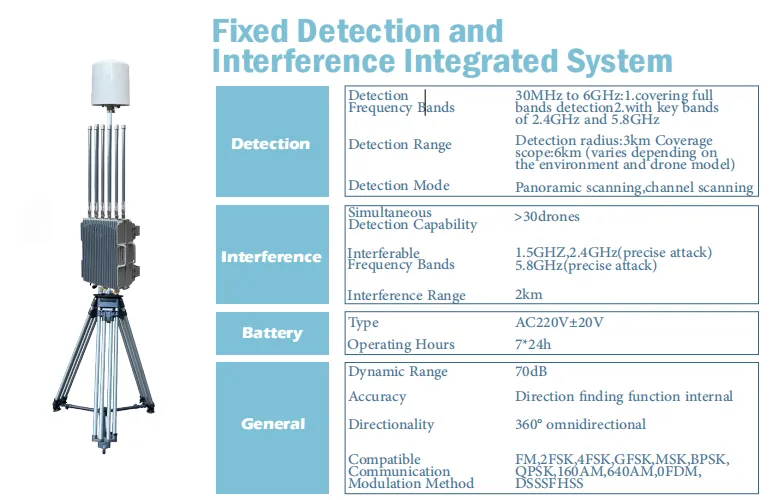
Detection frequency30 MHz to 6 GHz, with 2.4 GHz and 5.8 GHz as key bands
Detection radiusUp to 3 km
Coverage scopeUp to 6 km, depending on the site and the drone
Detection modePanoramic scanning, channel scanning
Simultaneous detectionMore than 30 drones
Interference bands1.5 GHz, 2.4 GHz and 5.8 GHz, with precise attack on 2.4 GHz and 5.8 GHz
Interference rangeUp to 2 km
Direction findingBuilt in
Power supplyAC 220 V ±20 V
Dynamic range70 dB
Supported modulationFM, 2FSK, 4FSK, GFSK, MSK, BPSK, QPSK, 16QAM, 64QAM, OFDM, DSSS/FHSS
MountingFixed mast or tripod installation

Installation & Site Planning

The station installs as permanent infrastructure: a mast or tripod carries the antenna array and the control unit is mounted alongside it. Siting does most of the work. A clear line of sight from a high point on the perimeter gives the most useful coverage, because walls, cell blocks, water tanks and mature trees all cast radar shadows that have to be worked out from a site plan rather than guessed at. That review is what turns a coverage figure on paper into a footprint that fits your grounds, and it is where any permanent installation should start.

Ordering & Deployment

  1. Share your site layout and the drone activity you have seen — where it appears, how often, and what it tends to carry. We use that to shape the anti drone solution for your perimeter.
  2. Confirm the mounting point, the power supply and the cable route with your facilities team, so the installation can be planned around your duty schedule.
  3. Agree who watches the system day to day and who is called when a track appears; the response procedure matters as much as the hardware.
  4. Ask us about documentation, commissioning support and operator training for the team who will run the station.
  5. Settle delivery and service details with your quotation — packing, shipping arrangements and after-sales cover — before the installation date is fixed.

FAQ

Q1. What does the station look like on site?

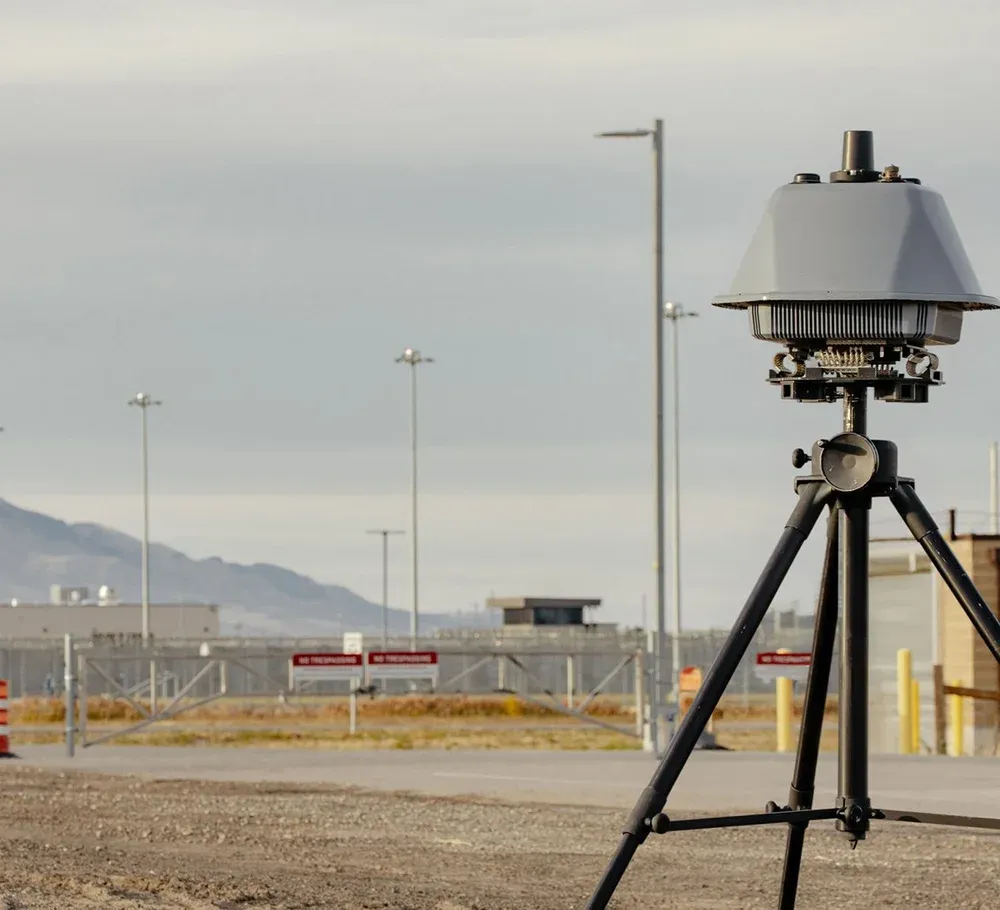
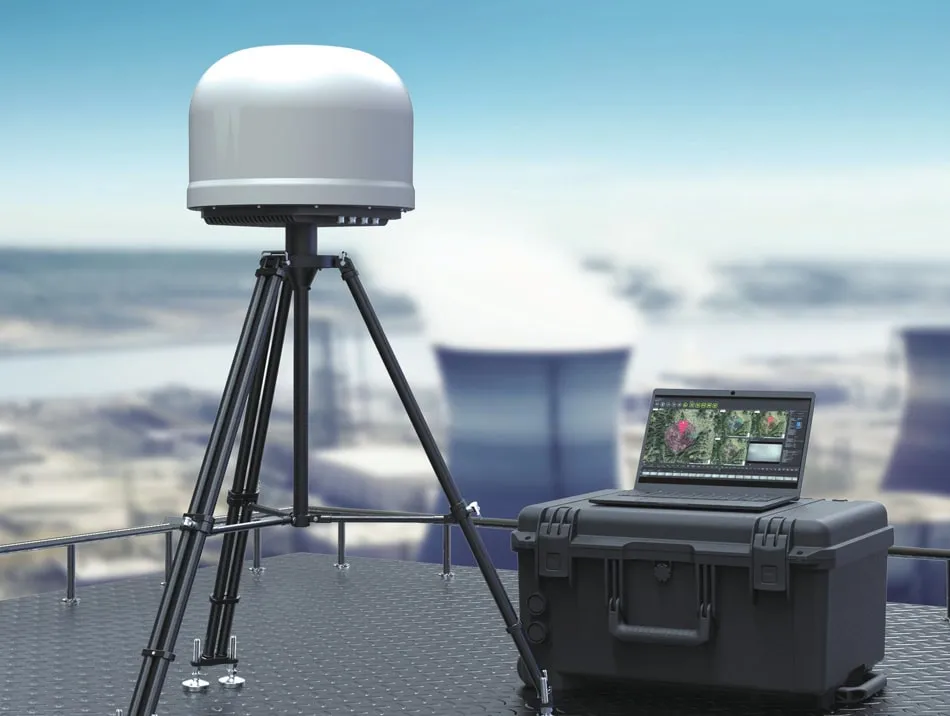
A vertical antenna array is carried on a mast or tripod, with a white radome at the top and a grey control unit mounted at the base. It is built as a permanent anti drone solution rather than something that is set up and packed away, so it sits alongside lighting columns and camera masts on a perimeter.

Q2. How is this different from a handheld drone detector?

A handheld unit is carried by a patrol officer and used for a spot check of one area. This station stays on watch from a fixed point and carries its own drone jammer, so the site does not depend on someone being in the right place with the right device. Many teams use both: the fixed station for the perimeter, handheld units for verification beyond it.

Q3. Does it still work at night or in poor visibility?

Yes. This anti drone equipment detects by radar, so darkness, fog and heavy rain do not blind it the way they limit an optical camera. The station is built for unattended operation through long shifts, and the control room only needs to look at it when something is actually crossing the perimeter.

Q4. Does the station tell us where the drone came from?

It goes further: the direction-finding section measures the bearing of the control link as well as the aircraft, so an operator gets a direction to work from instead of a general warning that something is up there. That bearing is what a response team needs when the launch point turns out to be outside the wall.

Q5. Can it work with the cameras and control room we already have?

Yes. The station is usually planned as one layer in a wider setup rather than a replacement for everything else. It can feed a control room alongside existing cameras, radar and counter UAS equipment, so operators keep a single picture of the airspace instead of switching between systems. Send us what you run and we will confirm how it fits.

Q6. Can it cope with several drones arriving together?

Multiple aircraft are tracked as separate targets, each with its own path and bearing, so a group flight does not collapse into one alarm. This anti drone defense system keeps the tracks apart through the incident, which matters when a drop attempt is flown by two or three machines at once.