Choosing the Right Detection Hardware Form Factor

Choosing the Right Detection Hardware Form Factor

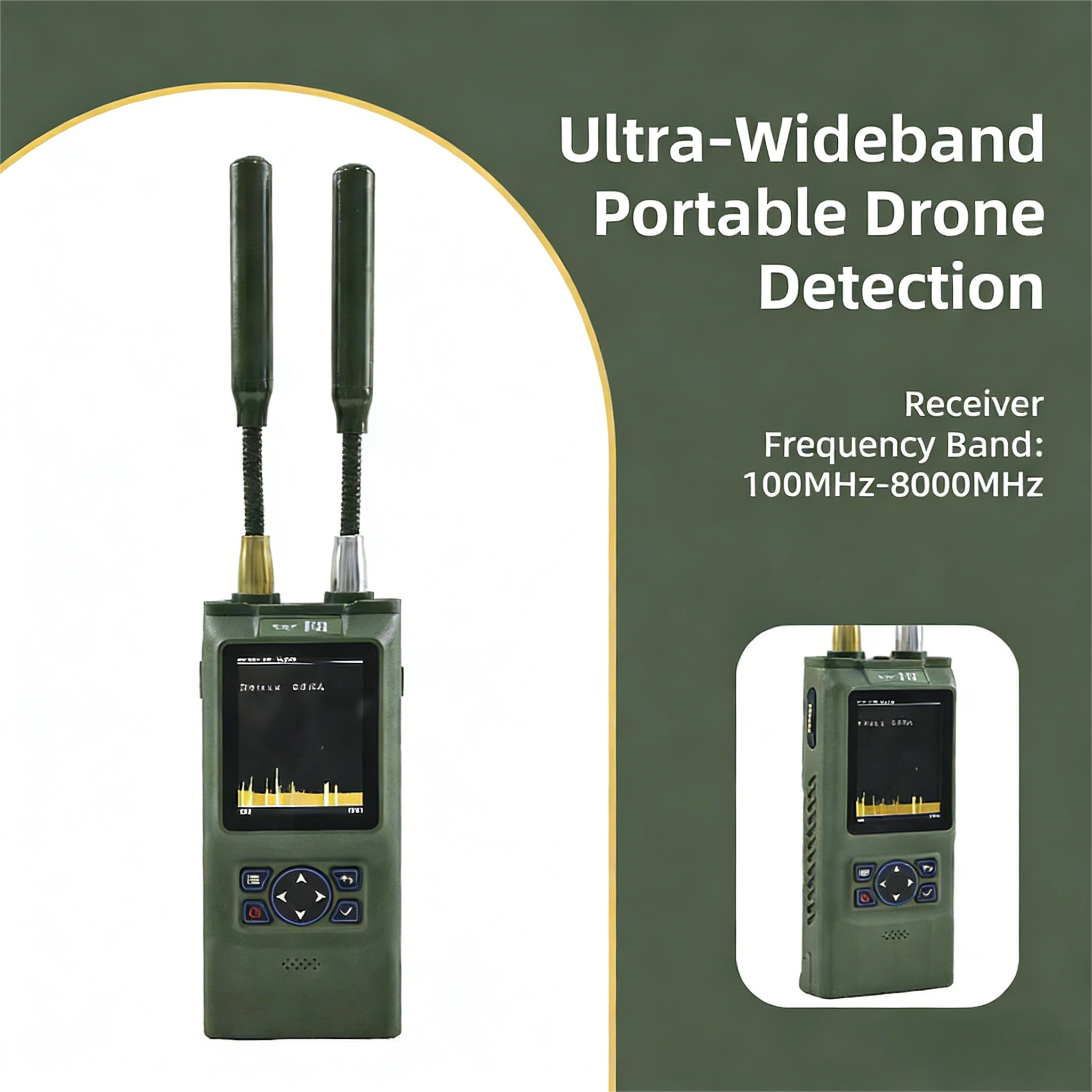
Counter-UAS planning starts with one question: how will the equipment be carried? A fixed site, a foot patrol and a vehicle convoy each need a different shape of hardware, so the fastest way to narrow a shortlist is to compare what a body-worn drone detector can do against a stationary installation. For teams that work on foot, the SIG-W08 handheld drone detector covers 100 MHz–8 GHz in a single unit, with a replaceable directional antenna and a magnetic interface to backpack-style countermeasure equipment.

100-8000mhz Drone Detector 8G Full Band Detector Tatusky Anti Drone Security Handheld Drone Detector Anti Drone System,Your low-altitude defense expert,100-8000mhz Drone Detector 8G Full Band Detector Tatusky Anti Drone Security Handheld Drone Detector Anti Drone System

Handheld, Wearable, Vehicle-Mobile and Fixed Compared

The same six questions decide every form factor. Where a figure is published for the SIG-W08 platform it is shown; where a figure is not published, the cell is deliberately left open so it can be specified in your RFQ rather than assumed.

Form factor Band coverage Direction finding Data transmission Mitigation linkage Customization Tender documentation
Handheld detector (SIG-W08)One operator on foot; patrol, escort and spot checks 100 MHz–8 GHz, ultra-wideband full spectrum Replaceable directional antenna Bluetooth to terminal devices Magnetic interface to backpack countermeasure equipment Specify in RFQ Specify in RFQ
Wearable detector (SIG-W08)Body-worn use linked to a countermeasure backpack 100 MHz–8 GHz, ultra-wideband full spectrum Replaceable directional antenna Bluetooth to terminal devices Magnetic interface to backpack countermeasure equipment Specify in RFQ Specify in RFQ
Vehicle-mobileConvoy and moving patrol coverage Specify in RFQ Specify in RFQ Specify in RFQ Specify in RFQ Specify in RFQ Specify in RFQ
Fixed stationaryPerimeter and site-wide coverage Specify in RFQ Specify in RFQ Specify in RFQ Specify in RFQ Specify in RFQ Specify in RFQ

The handheld and wearable rows reflect the published specifications of the SIG-W08 platform. Blank entries are marked rather than filled, which tells a tender reader exactly which questions are still open.

Handheld and Wearable Detection: What SIG-W08 Actually Provides

This is the only class on the page with a named, documented unit. Each capability below is paired with the decision it forces during equipment selection.

SIG-W08 full-band drone detector unit in operation
Model No. SIG-W08 — 100 MHz–8 GHz full-band handheld and wearable detection unit.
  • Full-spectrum coverage from 100 MHz to 8 GHz

    One unit covers every MHz across the stated range, performs analog video transmission signal detection in real time for each drone frequency band with an ultra-low false alarm rate, and displays relevant signal data at the same time. Decision: replace two or three band-limited devices with one, and add your required band list to the RFQ so coverage is confirmed in writing.

  • Direction finding with a replaceable directional antenna

    The platform supports replacement of the directional antenna, which is what turns a detection into a bearing. Decision: confirm the antenna type you need for your band plan and operating terrain before ordering.

  • Magnetic interface to backpack-style countermeasure equipment

    Detection can be linked to countermeasure gear through a magnetic interface, keeping detection and mitigation in one operator workflow. Decision: verify the countermeasure unit you already own uses a compatible interface before you commit.

  • Bluetooth data transmission to terminal devices

    Viewing data is transmitted in real time to terminal devices for remote viewing. Decision: list the phones, tablets or consoles your team actually carries and confirm compatibility in the RFQ.

  • Real-time drone video capture with FPV first-person view

    The device captures simulated video from drones within the 100 MHz–8 GHz range in real time and allows first-person viewing of FPV camera video information. Decision: decide whether video capture is a field-verification tool, a training aid, or both — that changes how many operators need the unit.

What a Fixed Detection and Mitigation Installation Contains

A fixed installation is a system, not a device. It is built from a detection node that watches the airspace, a processing and alerting layer that decides what the signal means and who is told, and a mitigation linkage that hands the decision to a jammer or suppressor. Each layer is procured and documented separately, and each one constrains the others.

Before you request a fixed-system quote, you should be able to answer four questions in writing: what airspace must be covered and from which mounting points; what happens in the seconds after a detection, and who authorises a response; how the detection layer connects to the mitigation layer on site; and what compliance evidence your authority, insurer or tender requires.

Site-wide installations follow a documented procurement path, and the stationary detection and jamming systems listed further down this page are the class of equipment that path leads to. Confirm configuration, range and integration points against your own site survey rather than assuming they carry over from a mobile unit.

Detection nodeAirspace monitoring and signal recognition
Processing and alertingClassification, decision, operator notification
Mitigation linkageJammer or suppressor activation path

Generic fixed-installation sequence. Confirm the exact configuration for your site in the RFQ.

Scenario to Specification: Which Decision Comes First

Each deployment scenario forces one specification decision before any other. Settle it in that order and the equipment class usually selects itself.

Scenario-led decisions

  • Single operator on foot: coverage versus portability comes first. A full-band 100 MHz–8 GHz unit removes the need to pre-select a band, so lock the band list and the antenna type in the RFQ.
  • Patrol team on foot: the interface between detection and mitigation comes first. Where detection links magnetically to backpack-style countermeasure equipment, one operator can carry both roles.
  • Vehicle convoy: mounting and integration come first. Request the mounting, integration and linkage figures in the RFQ rather than assuming they transfer from a hand-carried unit.
  • Fixed site or perimeter: the detection-to-mitigation sequence comes first. Define the chain, then price the nodes.

Decision sequence at a glance

  • Step 1 — Define the airspace. Which bands, which directions, which hours. This decides whether full-spectrum coverage is required or a narrower band set is acceptable.
  • Step 2 — Define the response. Who reacts, how fast, and with what equipment. This decides whether a mitigation linkage interface is mandatory.
  • Step 3 — Define the data path. Where viewing data must appear and who reviews it afterwards. This decides the terminal devices and output format.
  • Step 4 — Define the paperwork. Tender, compliance and handover documents. This decides what must be quoted alongside the hardware rather than after it.

Fields to Fill In Before You Request a Quote

A complete RFQ gets a usable answer the first time. Send these fields together, and quote back the published figures you already have so nothing is re-negotiated later.

Technical fields

  • Frequency bands to cover — list every band, and state whether 100 MHz–8 GHz full-spectrum coverage is required.
  • Coverage type — ultra-wideband full spectrum, or a directed band set.
  • Direction finding — state whether bearing information is required and with which antenna type.
  • Countermeasure linkage — name the countermeasure equipment you intend to link to, and its interface.
  • Data path — the terminal devices that must receive viewing data, and whether Bluetooth transmission is sufficient.
  • Video capture — whether real-time FPV video capture within 100 MHz–8 GHz is required for field verification or training.

Commercial, customization and documentation fields

  • Quantity and deployment count — how many operators, vehicles or sites must be equipped.
  • Customization — frequency solutions, branding or packaging changes you need evaluated.
  • Documentation — the tender, compliance or handover documents your buyer requires.
  • Destination and timing — delivery location and the date the equipment must be operational.
  • Published figures to reconfirm — 100 MHz–8 GHz detection range, replaceable directional antenna, Bluetooth transmission, magnetic countermeasure interface, and real-time FPV video capture for the SIG-W08 platform.
  • Open items — price, lead time, warranty, power, weight and detection distance are not published on the product page, so ask for them explicitly.

Request a Quote for Your Deployment Scenario

Send your band list, deployment type, quantity and documentation requirements through the quote form. Frequency customization, bulk quantities and branding requirements can be discussed in the same request, so the quotation covers hardware, configuration and paperwork together.

  • Email: faye@signowa.com
  • Phone: +86 18025425918
  • Building 4, Zone 1, Fuqiao Industrial Zone, No. 102, Yongfu Road, Bao'an District, Shenzhen City, Guangdong Province, China

Related Reading

Three notes to help clarify product requirements before contacting the supplier.

How to Choose a Handheld Drone Detector Manufacturer for Security Projects

Security integrators need a handheld drone detector manufacturer that can explain the detector’s project role, show usable specifications, and support a clear RFQ path.

Read article

Choosing a UAV Detector Supplier for Mobile Security Programs

Mobile security teams need UAV detection equipment that can travel with patrol units, escort vehicles, and temporary posts while fitting the operational conditions of each assignme

Read article

Handheld Drone Detectors for Direction Finding in Security Patrols

A handheld drone detector with direction finding gives patrol teams a practical way to check for drone-related RF activity, develop a direction clue, and share field observations d

Read article

Frequently Asked Questions

what frequency range does the sig-w08 drone detector cover?

the product page states detection coverage from 100 mhz to 8 ghz, described as ultra-wideband full-spectrum coverage. the device performs analog video transmission signal detection in real time for each drone frequency band with an ultra-low false alarm rate while simultaneously displaying the relevant signal data.

can the unit find the direction of a drone signal?

yes. the platform supports replacement of the directional antenna, which is the direction-finding element. tell us which antenna type suits your band plan and operating terrain when you request a quote.

how does it link to countermeasure equipment?

it connects to backpack-style countermeasure equipment through a magnetic interface, which keeps detection and mitigation in one operator workflow. check the interface on the countermeasure unit you intend to pair with before ordering.

how is viewing data transmitted to operators?

the device supports bluetooth data transmission, sending viewing data to terminal devices in real time for remote viewing. confirm compatibility with the phones, tablets or consoles your team already carries.

does it capture drone video?

yes. the device captures simulated video from drones within the 100 mhz–8 ghz range in real time and allows first-person fpv viewing of the camera video information, which is useful for field verification and operator training.

how do i request pricing, customization or bulk quantities?

price, lead time, warranty, power, weight and detection distance are not published on the product page, so these come through the quote route: faye@signowa.com or +86 18025425918. include your frequency requirements, quantity and documentation needs in the same message so customization and bulk options can be quoted together.