


|
Item
|
Spec.
|
Remarks
|
|
|
Frequency Range
|
850-960 MHz
|
Bandwidth Range±10MHz
|
|
|
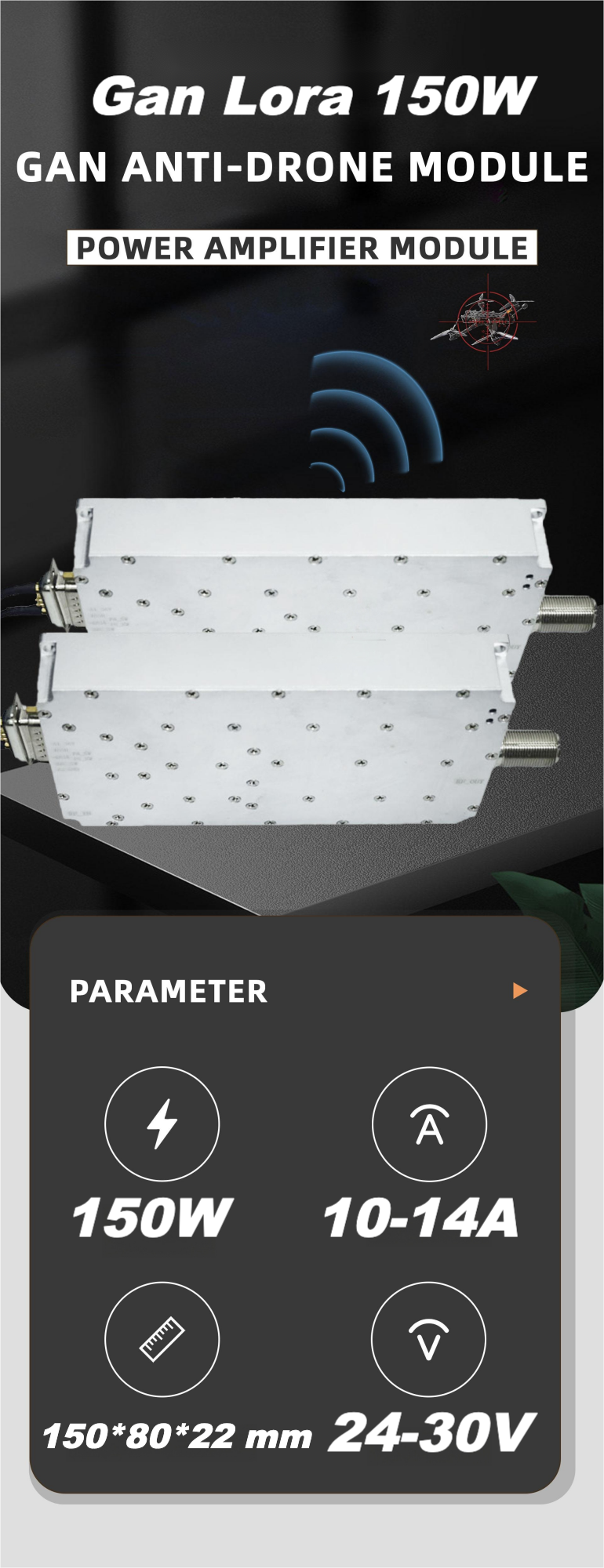
Working Voltage
|
28V
|
24-30V
|
|
|
Working current
|
10-14A
|
output 150W
|
|
|
Analog sweeping speed
|
Customized 50-300KHz
Standard 120 KHz |
8μ/s
|
|
|
Output Power (Max)
|
51.8±1 dBm
|
150W
|
|
|
Gain (Max)
|
51.8±1 dB
|
|
|
|
Ripple in Band
|
≤ 3 dB
|
Peak
|
|
|
Bandwidth adjustment
|
Yes
|
By screw
|
|
|
Center adjustment
|
Yes
|
By screw
|
|
|
Enable control
|
Customize
|
24-28V
|
|
|
Input power (Max)
|
≤ +10dBm
|
Optional (If signal source from Subscriber)
|
|
|
Input Signal Source
|
Built-in high-speed noise modulation signal source
|
Optional
(customize VCO, DDS or SDR) |
|
|
Output VSWR
|
≤1.5
|
Inside circulator, VSWR protect
|
|
|
High Low
Temperature test |
Working Temperature
|
-20~+65℃
|
Working properly
|
|
Gain Stability
|
±1 dB
|
at
-20℃~+65℃ |
|
|
Power stability
|
±1 dB
|
at
-20℃~+65℃ |
|
|
Power supply Port
|
Positive and negative lines
|
24-28V; GND;
(optional: Enable control wire) |
|
|
Shell Material
|
Aluminum with natural color oxide sand blasting
|
|
|
|
Vibration Need
|
Meet the load need of moving vehicle
|
|
|
|
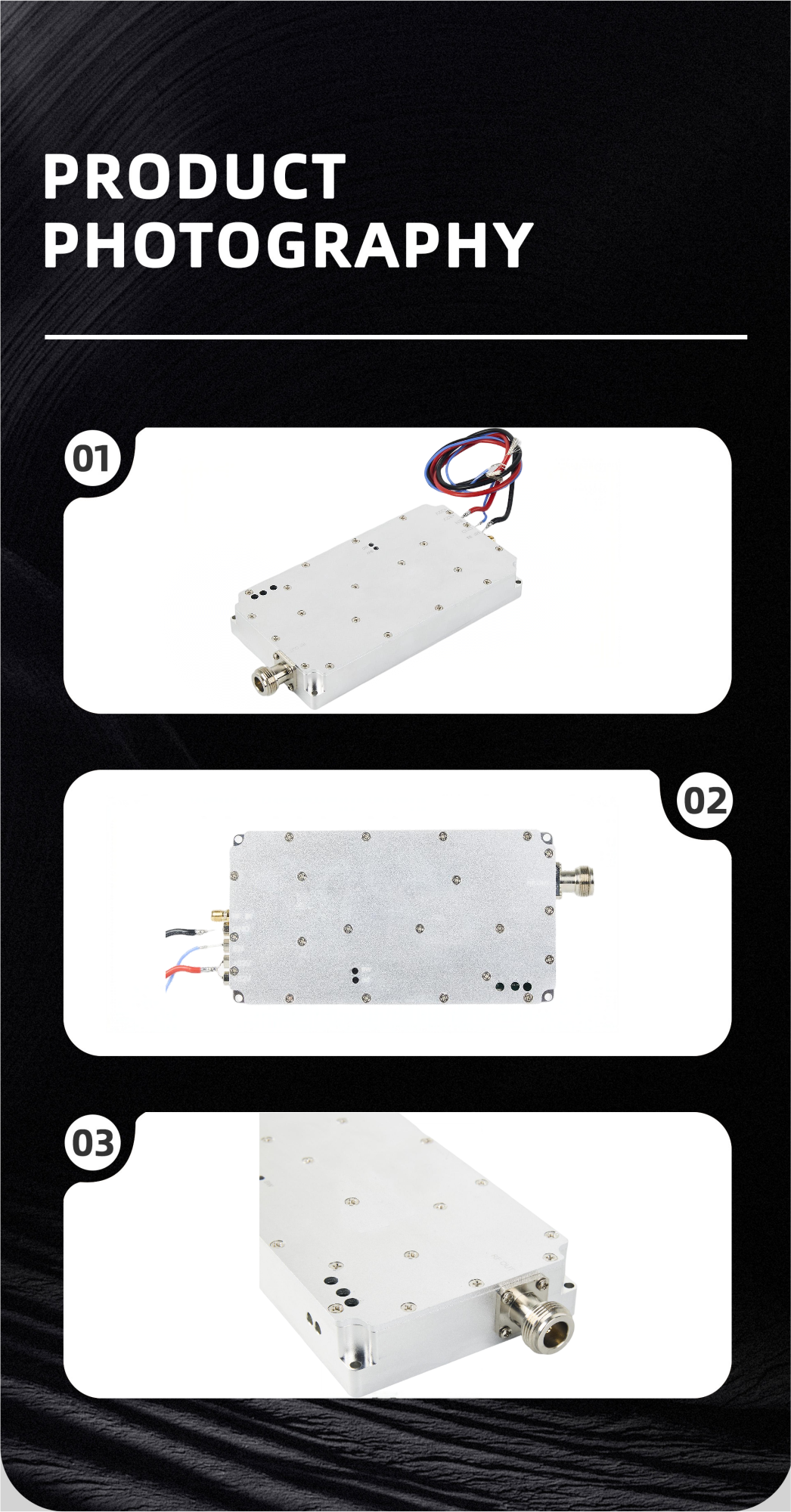
RF output connector
|
SMA-Female
|
|
|
|
LED indicator light
|
Power ON/OFF
|
|
|
|
Dimension
|
150*80*22 mm
|
|
|
|
Installation Dimension
|
114.3*74*22 mm
|
|
|
|
Screw Size
|
M2.5
|
|
|
|
Weight
|
8000g
|
||


Modulation & Sweeping Control
The 900 MHz-class window carries a large share of long-range FPV control, video and LoRa telemetry traffic, which is why it is often one of the first suppression channels specified in a multi-band build. Because the module works on a defined slice of that window instead of the whole spectrum, output is concentrated on the link that actually needs covering. Drone defense companies typically mount it in fixed perimeter masts at prisons, airports and utility sites, in mobile checkpoints and patrol vehicles, and in temporary event coverage where a mast goes up for a few days. Operators normally give each band its own antenna and let the system controller decide which channel is live.
Choosing between a handheld detector, a vehicle-mounted or tripod-deployed system, a fixed passive detection installation, and a GaN suppression module comes down to your site, your threats and your existing equipment. Our team works with integrators and security buyers from your first enquiry: we help match the right detection range, band coverage and output level to the job, support customisation of module parameters, and stay available through installation, commissioning and troubleshooting. Send us your deployment scenario and we will recommend a configuration.
It is a module. The unit provides the amplification and modulation stage, while your build supplies the DC feed, the controller that arms the channel, the antenna and the housing it sits in. That is why it is usually specified as one channel inside an anti drone jammer alongside other bands, with the system controller deciding when each channel is active.
Yes. A high-speed noise modulation source is fitted as standard, but the input can also be taken from your own VCO, DDS or SDR. Teams that already generate their own waveform in an anti drone solution use that route so the channel follows their existing timing and shaping. Keep the external source inside the module's rated input window.
Start from the links you need to cover. This anti drone module works in the 900 MHz class, where much long-range FPV control, video and LoRa traffic sits. If your priority is low-band control links or the higher video bands, another module in the range is the better fit, and multi-band systems often run several of them side by side from one controller.
Both approaches are used. Most anti drone companies give each band its own antenna and either run the channels together or group them from the controller, depending on the threat. When channels run together, keep the antennas separated, check that your DC supply covers the combined draw of the rack, and watch for one channel desensitizing another.
The aluminum case is designed to pass heat into whatever it is bolted to, so a metal panel is the normal mounting surface and a thermal pad or compound helps. In a sealed counter UAS cabinet, leave room for air to move around the module and avoid stacking it hard against another heat source. Check the case temperature after a long run before closing the cabinet up.
Yes. The module is specified for moving-vehicle duty, and its vibration and mounting requirements are set with that in mind. Bolt it to a rigid surface, support the coax so it is not taking the strain, and check that the DC feed from the vehicle or generator is stable before wiring. For temporary masts and vehicle-mounted counter UAS installations, allow for a weatherproof housing around the module.


