


|
Item
|
Spec.
|
Remarks
|
|
|
Frequency Range
|
200-400Mhz
|
Bandwidth Range±10MHz
|
|
|
Working Voltage
|
28V
|
24-30V
|
|
|
Working current
|
10-15A
|
output 200W
|
|
|
Analog sweeping speed
|
Customized 50-300KHz
Standard 120 KHz |
8μ/s
|
|
|
Output Power (Max)
|
51.8±1 dBm
|
200W
|
|
|
Gain (Max)
|
51.8±1 dB
|
||
|
Ripple in Band
|
≤ 3 dB
|
Peak
|
|
|
Bandwidth adjustment
|
Yes
|
By screw
|
|
|
Center adjustment
|
Yes
|
By screw
|
|
|
Enable control
|
Customize
|
24-28V
|
|
|
Input power (Max)
|
≤ +10dBm
|
Optional (If signal source from Subscriber)
|
|
|
Input Signal Source
|
Built-in high-speed noise modulation signal source
|
Optional
(customize VCO, DDS or SDR) |
|
|
Output VSWR
|
≤1.5
|
Inside circulator, VSWR protect
|
|
|
High Low
Temperature test |
Working Temperature
|
-20~+65℃
|
Working properly
|
|
Gain Stability
|
±1 dB
|
at
-20℃~+65℃ |
|
|
Power stability
|
±1 dB
|
at
-20℃~+65℃ |
|
|
Power supply Port
|
Positive and negative lines
|
24-28V; GND;
(optional: Enable control wire) |
|
|
Shell Material
|
Aluminum with natural color oxide sand blasting
|
||
|
Vibration Need
|
Meet the load need of moving vehicle
|
||
|
RF output connector
|
N-type
|
||
|
LED indicator light
|
Power ON/OFF
|
||
|
Dimension
|
200*100*23 mm
|
||
|
Screw Size
|
M2.5
|
||
|
Weight
|
1000g
|
||
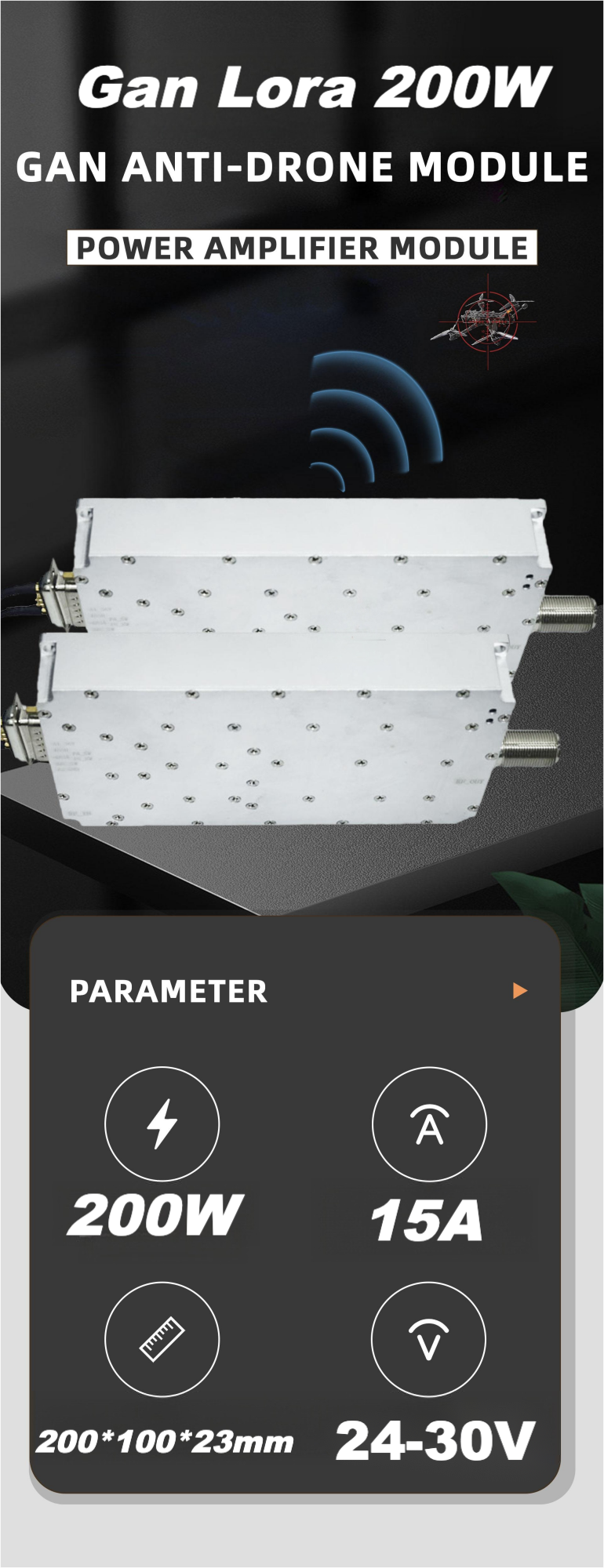
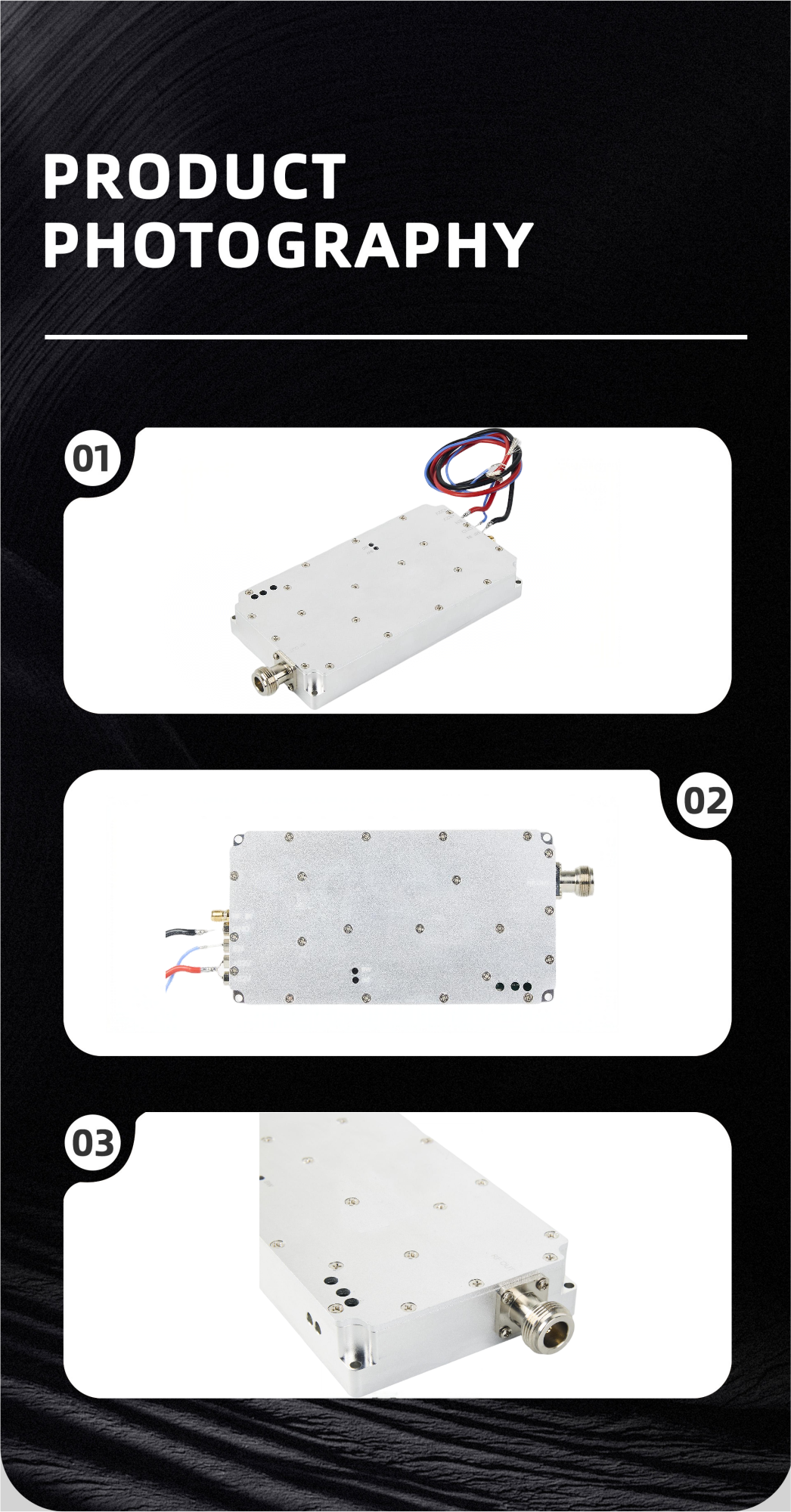


This low-band GaN module is a suppression amplifier built to sit inside a complete assembly rather than stand on its own: you bring the antenna, the DC supply and the housing, and the block delivers the RF output that disrupts FPV video and control links. For drone defense companies putting a platform together, it is the part that covers the bottom of the spectrum, where higher-band units do not reach. Integrators, in-house RF teams and equipment suppliers fit it into fixed stations, vehicle platforms and portable units, then cable it in and commission it on site. The interface is deliberately plain — one DC feed and one antenna run — so the module drops into an existing build without extra hardware.
| Frequency range | 200-400 MHz |
| Instantaneous bandwidth | ±10 MHz |
| Output power (max) | 200 W / 51.8 ± 1 dBm |
| Gain (max) | 51.8 ± 1 dB |
| In-band ripple | ≤ 3 dB |
| Working voltage | 28 V nominal (24-30 V) |
| Working current | 10-15 A |
| Working temperature | -20 to +65 °C |
| Gain and power stability | ±1 dB from -20 to +65 °C |
| Dimensions | 200 × 100 × 23 mm |
| Weight | 1000 g |
Every unit carries a built-in high-speed noise modulation source, so an amplifier can be bench-tested and commissioned without waiting on an exciter. If your architecture prefers to supply the drive signal itself, the input accepts up to +10 dBm and we can configure the module around a VCO, DDS or SDR source instead. The choice usually comes down to how much control your system needs over the modulation profile: a self-contained block is quicker to deploy, while an external exciter lets you shape waveforms in software. Remote switching is available through an optional enable control input, which helps where the module sits in a rack or a vehicle and cannot be reached easily. Tell us which arrangement you plan to use and we will set the unit up to match.
Choosing between a handheld detector, a vehicle-mounted or tripod-deployed system, a fixed passive detection installation, and a GaN suppression module comes down to your site, your threats and your existing equipment. Our team works with integrators and security buyers from your first enquiry: we help match the right detection range, band coverage and output level to the job, support customisation of module parameters, and stay available through installation, commissioning and troubleshooting. Send us your deployment scenario and we will recommend a configuration.
It is built for the low band, which carries FPV video and control traffic — links that sit outside the reach of higher-band hardware. This is one element of the anti drone solutions our customers assemble, and it works by suppression rather than detection, so the practical result depends on the antenna you pair it with and the drive level you set.
Yes. Peak bandwidth and center frequency are both adjusted by screw, so a technician can trim the anti drone module on site without returning it or swapping hardware. Analog sweeping speed is 120 kHz as standard, with 50-300 kHz available where a different sweep suits your build. Both adjustments are made at the amplifier itself, so no external controller is needed.
Output VSWR is held to 1.5 or lower and an internal circulator provides VSWR protection, so a poor antenna match does not put the amplifier stage at risk. That protection earns its keep during commissioning, when antennas are swapped and cables are re-routed before a site goes live.
Yes. The vibration requirement is written for moving-vehicle loads, and the housing is aluminium with a natural oxide sand-blasted finish that stands up to handling. Units mount through M2.5 points, so they can be fixed to a vehicle plate or a rack shelf without a custom bracket.
Yes. It is a single-band amplifier, so most counter uas installations run it alongside modules covering the other bands a site needs, driven from one control layer. Because each block is tuned to its own band, the combined set covers the spectrum without the modules working against each other.
A status LED shows power ON/OFF, so the first check is simply whether the lamp is lit. From there, confirm that the drive signal is reaching the input and that the antenna cable is properly seated at the output. If the lamp stays dark, work back through the supply connections before looking at the RF chain.


