


|
Item
|
Spec.
|
Remarks
|
|
|
Frequency Range
|
2350-2550 MHz
|
Bandwidth Range±10MHz
|
|
|
Working Voltage
|
28V
|
24-30V
|
|
|
Working current
|
10-15A
|
output 200W
|
|
|
Analog sweeping speed
|
Customized 50-300KHz
Standard 120 KHz |
8μ/s
|
|
|
Output Power (Max)
|
51.8±1 dBm
|
200W
|
|
|
Gain (Max)
|
51.8±1 dB
|
|
|
|
Ripple in Band
|
≤ 3 dB
|
Peak
|
|
|
Bandwidth adjustment
|
Yes
|
By screw
|
|
|
Center adjustment
|
Yes
|
By screw
|
|
|
Enable control
|
Customize
|
24-28V
|
|
|
Input power (Max)
|
≤ +10dBm
|
Optional (If signal source from Subscriber)
|
|
|
Input Signal Source
|
Built-in high-speed noise modulation signal source
|
Optional
(customize VCO, DDS or SDR) |
|
|
Output VSWR
|
≤1.5
|
Inside circulator, VSWR protect
|
|
|
High Low
Temperature test |
Working Temperature
|
-20~+65℃
|
Working properly
|
|
Gain Stability
|
±1 dB
|
at
-20℃~+65℃ |
|
|
Power stability
|
±1 dB
|
at
-20℃~+65℃ |
|
|
Power supply Port
|
Positive and negative lines
|
24-28V; GND;
(optional: Enable control wire) |
|
|
Shell Material
|
Aluminum with natural color oxide sand blasting
|
|
|
|
Vibration Need
|
Meet the load need of moving vehicle
|
|
|
|
RF output connector
|
N-type
|
|
|
|
LED indicator light
|
Power ON/OFF
|
|
|
|
Dimension
|
200*100*23 mm
|
|
|
|
Screw Size
|
M2.5
|
|
|
|
Weight
|
1000g
|
||
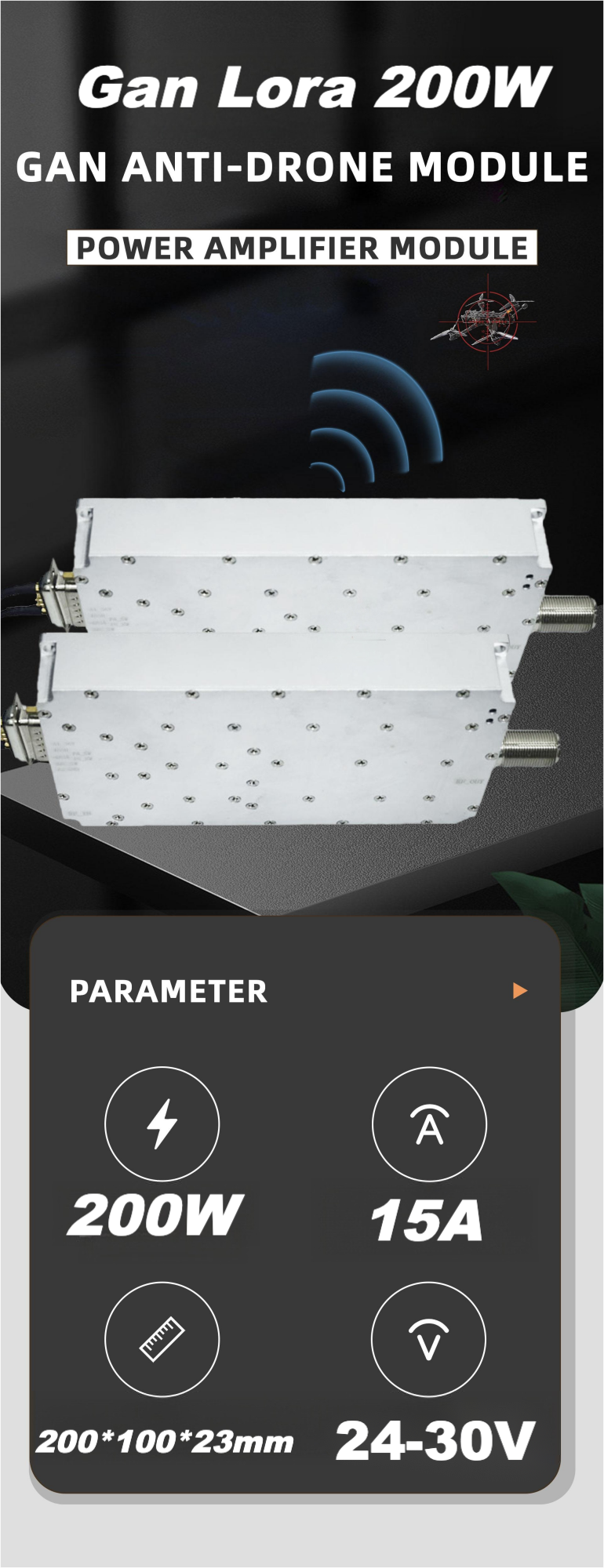
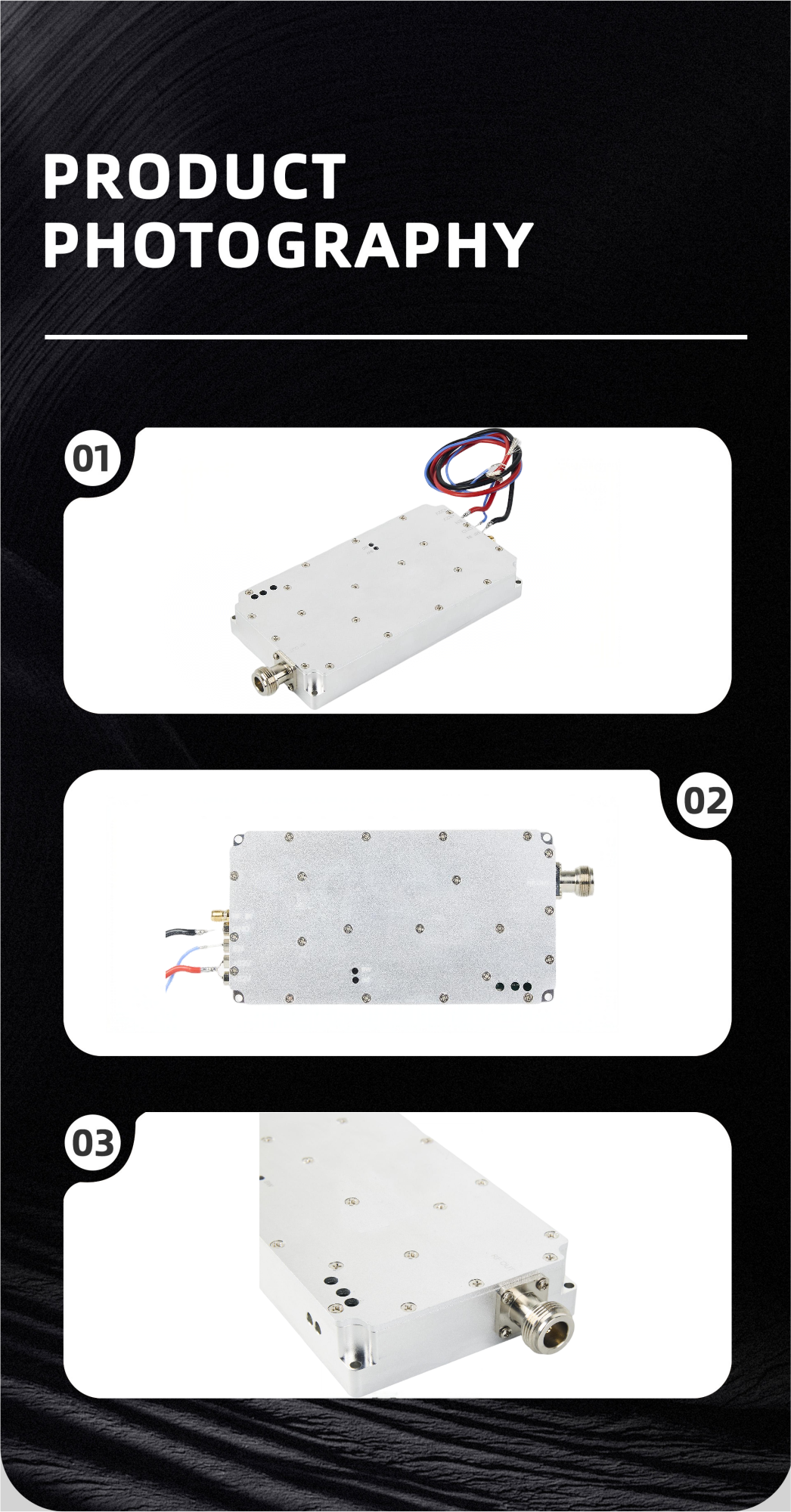


The housing is machined aluminium with a natural-colour oxide sand blast. The metal is a thermal path as much as an enclosure: it carries heat away from the GaN output devices during long suppression runs, which is what keeps the amplifier working at its rated level rather than fading as the case warms.
The blasted surface is matte and non-reflective, and it takes the scuffs that come with repeated mounting, cable work and transport — the treatment suits equipment that moves between vehicles, masts and outdoor cabinets. Mounting points are machined into the same body, so the module fixes down without a separate bracket or cradle. Anti drone companies redeploy this kind of hardware often, so the shell is specified to survive handling rather than to look new in a showroom.
| Working voltage | 24-30V DC (28V nominal) |
| Working current | 10-15A at 200W output |
| Power supply port | Positive and negative lines, GND, optional enable control wire |
| Enable control | 24-28V, customizable |
| Operating temperature | -20 to +65 °C |
| Gain stability | ±1 dB from -20 °C to +65 °C |
| Power stability | ±1 dB from -20 °C to +65 °C |
| Vibration | Rated for the load demands of a moving vehicle |
| Housing dimensions | 200 × 100 × 23 mm |
| Weight | Approx. 1000 g |
| Status indicator | LED, power ON/OFF |
Choosing between a handheld detector, a vehicle-mounted or tripod-deployed system, a fixed passive detection installation, and a GaN suppression module comes down to your site, your threats and your existing equipment. Our team works with integrators and security buyers from your first enquiry: we help match the right detection range, band coverage and output level to the job, support customisation of module parameters, and stay available through installation, commissioning and troubleshooting. Send us your deployment scenario and we will recommend a configuration.
This is the video-link window. Most FPV and consumer drone video downlinks sit in the 2.4GHz class, which is why it carries so much of what an operator sees on screen. In an anti drone jammer build it is usually the stage aimed at the live video feed, while other bands handle control and navigation links.
It is the RF power stage of a system rather than a handheld unit. You provide the DC supply, the antenna or combiner run and, unless you use the built-in source, the exciter signal. Anti drone companies typically buy it as the 2.4GHz stage of a multi-band build and mount it next to their other suppression stages.
Yes. Center frequency and peak bandwidth are set by screw adjusters on the housing, so a technician can trim the module to local spectrum conditions with a spectrum analyser in front of them. The bandwidth itself spans ±10MHz within the 2350-2550MHz window.
Yes. The module accepts an external input of up to +10 dBm, which suits a drone jammer rack that already has its own modulation source or signal generator. If you prefer a self-contained stage, the built-in high-speed noise modulation generator does the job without any extra equipment.
An internal circulator holds output VSWR at or below 1.5 and protects the output stage from reflected power. Treat it as a safety margin rather than a licence to run without a proper load: check the antenna and its connectors before the first power-up, and watch the panel LED at switch-on.
This model covers the 2.4GHz window at 200W. The wider module range covers other bands and other power levels, so an anti drone system that has to address several drone links can be assembled from more than one stage. Tell us which links you need to cover and we will point you to the modules that fit.


