


The SIG-DG03 drone detection and jamming system integrates detection and jamming, has 360° all-round detection capability, covers an ultra-wide spectrum of 50MHz-6GHz, can autonomously learn to identify unknown drones, handle multiple targets at the same time, is unmanned around the clock, has a whitelist function, adapts to complex electromagnetic environments, and uses omnidirectional countermeasure technology to counter drones in all directions. It is particularly good at identifying frequency-hopping drone signals.
The SIG-DG03 system is used for drone detection and jamming. The system integrates multiple technologies such as collaborative spectrum sensing and deep neural networks. Through radio detection technology, the system uses the received drone characteristic signals, big data processing, artificial intelligence and machine learning to effectively detect and identify low-altitude drones in the defense area; it uses radio jamming and blocking technology to achieve effective control of intruding drones. The system realizes low-altitude three-dimensional protection within a defense area radius greater than 5,000 meters, and has been widely used in major events and other fields.
·The best technical route in the industry, detection and interference are integrated, smaller and lighter
·Passive passive detection, 360° all-round, 50MHz-6GHz ultra-wide spectrum detection range
·It has the ability to autonomously learn and identify unknown drones, and can record their signal characteristics during drone flight, including industrial drones and consumer drones with standard broadband image transmission and frequency hopping image transmission,
·It can handle more than 10 targets at the same time, detect, identify and interfere
·All-day, all-weather, unmanned
·With whitelist function
·Unique intelligent gain and reference level patented design to adapt to the needs of complex electromagnetic environment detection
·Omnidirectional countermeasure, countermeasure drones in all directions
·Special frequency hopping signal recognition technology, which can identify frequency hopping drones
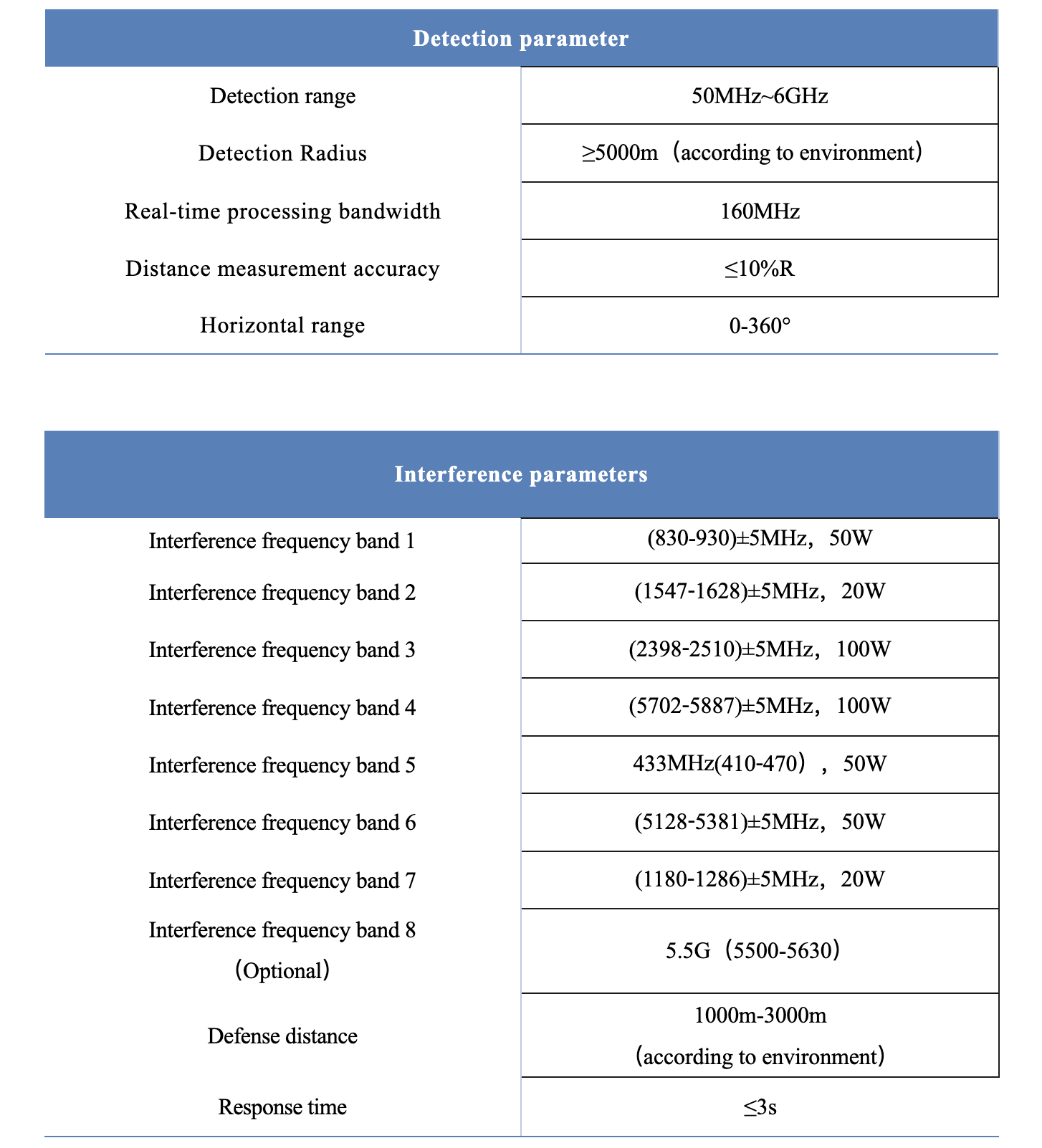


| Model | SIG-DG03 |
|---|---|
| System type | Fixed detection and jamming unit |
| Detection coverage | 360° omnidirectional |
| Spectrum range | 50MHz–6GHz |
| Detection method | Passive radio detection |
| Signal analysis | Collaborative spectrum sensing with deep neural network processing |
| Simultaneous targets | More than 10 |
| Identification | Self-learning recognition of unknown drone signals |
| Whitelist function | Supported |
| Countermeasure | Omnidirectional radio jamming and blocking |
| Protected radius | Greater than 5,000 m |
| Operation | All-day, all-weather, unmanned |
Once the unit is commissioned, the routine stays light. Antenna mounts and cable entries take the most wind load, so they are worth a glance on a regular walk-round — loose hardware on a fixed installation shows up as a drop in sensitivity long before anything fails outright. The housing is built to shed heat, so keep its surfaces and the air around it clear of dust, leaves and stacked equipment. Review the alert history now and then rather than only after an incident: patterns in when and where contacts appear are what tell you whether coverage still matches the site. Identification updates matter on a system that learns, because new drone models reach the market every year. Buyers who have worked with several anti drone companies know the difference between a unit that is supported after commissioning and one that is not, so ask how updates and spares are handled before installation.
The unit is designed to work in crowded electromagnetic environments, and the safeguard is preparation: an on-site survey of what is already transmitting, taken before commissioning, so the system is set up against that picture rather than around it. Radio rules differ from country to country, so confirm what applies where you operate before anything is switched on.
Not for the same circle of coverage. A separate unit earns its place when you want an independent second layer, or something portable that a patrol can carry beyond the fixed perimeter — for example when an event moves to a different part of the site for a day.
The anti drone defense system is built as fixed outdoor equipment, and the enclosure is made to sit on a mast or roof through the seasons. What it needs around it is airflow and a clear view of the sky. Wind loading and salt air are the two conditions most worth raising with us before the mounting is finalised.
Yes — it is designed to sit inside a wider counter uas setup rather than replace what you already run, taking the fixed-node role while your existing equipment keeps doing its own job. Tell us what you have and how it reports, and we will confirm how the pieces fit together.
Yes. Additional fixed nodes can be sited as a perimeter changes, and a new unit is normally placed so its circle overlaps the first and closes the gap between them. Extending coverage node by node is how drone defense companies usually work on a large site — one section at a time rather than one purchase for everything.
The anti drone system uses radio jamming and blocking to take control of the intruder's link rather than to damage the aircraft. What the drone does next depends on its own failsafe settings and on how its operator reacts — some turn back, some hover, some descend — so your response procedure should cover all three outcomes.


